
The ultra-cheap components available on ebay are a constant temptation, and perhaps like many of you, I took a risk on buying a cheap batch of fifty LM358 operational amplifiers for only $2 USD.
http://www.ebay.com/itm/291659048055
As with all eBay purchases the immediate concern is, are these components fakes?(Answer: probably yes)
I thought it would be an interesting learning experience to try and determine if these op-amps are a reasonable match to the manufacturers specifications.
So, these are our goals:
- Try and make sense of the parameters in an op-amp data sheet
- Determine if the eBay components are a reasonable match to the data sheet
Methodology
A lot of the op-amp’s key parameters can be tested with this simple relaxation oscillator circuit:
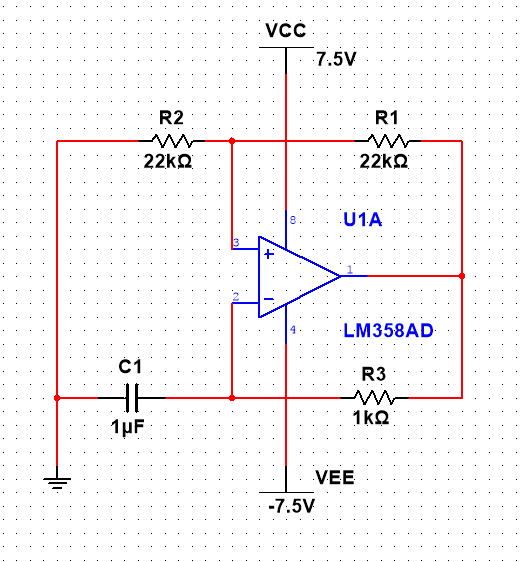
Using this circuit we can measure the op-amps:
- Output Swing
- Low Level Output Voltage
- Slew Rate
Let’s look at all three in some detail, and compare results measured from this circuit to the parameters in the datasheet.
Output Swing
The output swing is the voltage range that the op-amp can produce on its output. For example, if an op-amp can output can range between 2V to 10V, the output swing is 8V.
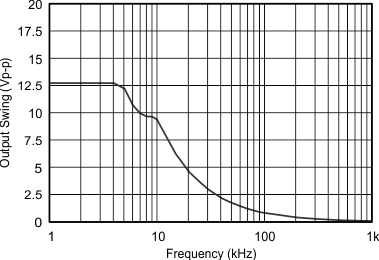
The LM358 data-sheet gives us the expected output swing when the supply voltage is 15 volts. You can also see the output swing degrades gradually with increasing frequency:
To measure the output swing we look at the highest and lowest voltages generated by the oscillator circuit:
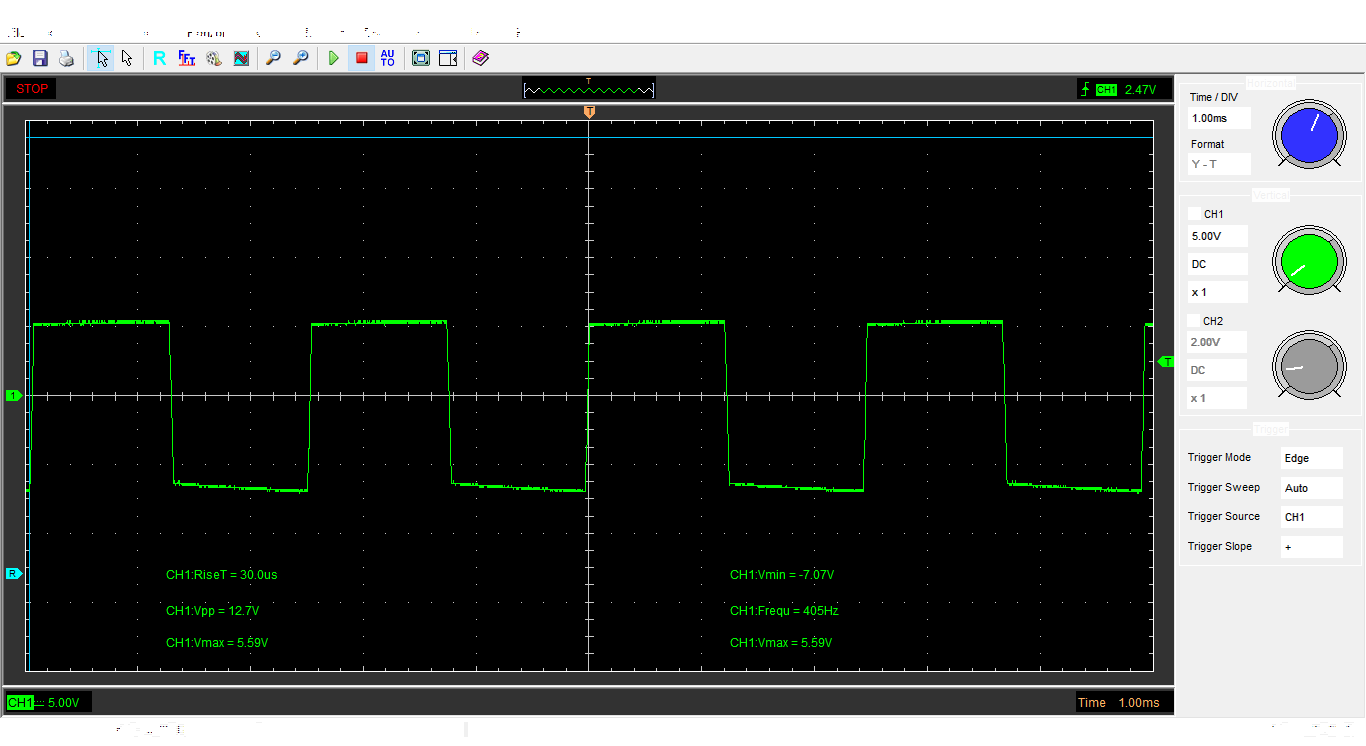
The minimum voltage produced by the oscillator was -7.07V, and the maximum was 5.59V. Giving us an output range of 12.7V. This matches up reasonably well with the 12.5V quoted in the datasheet.
Low Level Output Voltage
The Low Level Output voltage indicates how close the output of the amplifier can get to the negative supply rail. If the negative supply rail is 0V, and the lowest output of the amplifier is 2V. Then the low level output voltage is 2V.
An important feature of the LM358 is its output voltage can get very close to the negative supply voltage, with exactly how close depending on how much current is flowing into the amplifier
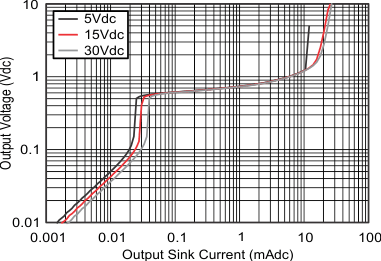
In our circuit, during the low output of the square wave, we are discharging about 4V peak from the capacitor via a 1k resistor; so roughly 4mA is being sunk by the LM358
From the above graph when sinking 4mA we’d expect our output voltage to be somewhere around 0.4 or 0.5V above the negative rail. So in our circuit, we’d expect the lowest output voltage to be around -7.1V
Let’s see what we get in practice:

The minimum here is -7.07V. This is quite close to our estimate of -7.1V we calculated from the data-sheet.
Slew Rate
The Slew Rate of an amplifier is how quickly the output voltage can change, or if you prefer, it’s the steepest slope of the output
The LM358 has a very slow slew rate of 0.3V/us so it should be fairly easy for us to measure this.
To get better view of the slope we increase our horizontal resolution and zoom in on the rising edge of our oscillator:

We can see that it took 3 and a bit divisions of 10us each to cover our peak to peak voltage of 12.5V
This means our slew rate is simply 12.5V/33us = 0.37V/us
This is slightly faster than our expected 0.3V/us but I think it’s close enough that we can give this a pass.
Summary
It seems the ultra-cheap LM358s I bought from eBay for $2 for 50 could be be legitimate. This testing isn’t comprehensive but it does confirm several key parameters match the LM358 specifications.
In this case I got lucky — there’s definitely a lot of people receiving fake components from ebay sellers!
 Silicon Junction
Leave a comment