
Starting out in electronics can be overwhelming — there are so many tools and gadgets to choose from. To help beginners get going without breaking the bank, I’m focusing on the two tools essential every project: a reliable soldering iron and a versatile multimeter. These are low-cost items I personally use and recommend.
Soldering Station
I can heartily recommend the KSEGR T12 soldering station — it’s fast, compact, and affordable. Here’s why I like it:
- Fast heating: reaches full temperature in under 10 seconds
- Ample power: 75 W is enough for virtually all hobby electronics
- Compact: small footprint, ideal for a crowded desk
- No extra power supply needed: unlike the Pinecil and some others
- Easy tip replacement: T12 tips are cheap and widely available
- Customizable handles: try different handles without replacing the whole unit
- Better overall value: cheaper than the Pinecil when you include the cost of tips
- High-quality compatibility: works with Hakko FX9501 handles and T12 tips, giving you the option to buy name-brand parts for the components that matter
- Standby & Sleep: Automatically lowers the tip temperature after a set period of inactivity. If left idle longer, the heater turns off completely. Both the idle temperature and timeouts are fully configurable. This prevents wasted power and reduces tip oxidation if the station is accidentally left on.
- Vibration Sensor: Detects movement to determine when the iron is being used, picked up, or set down. This allows the station to automatically wake from standby or delay sleep while the iron is in use.
- Quick-change cartridges: allow tips to be swapped in seconds, unlike older threaded tips such as the Hakko 900M soldering tip which must be screwed in and out of the iron.
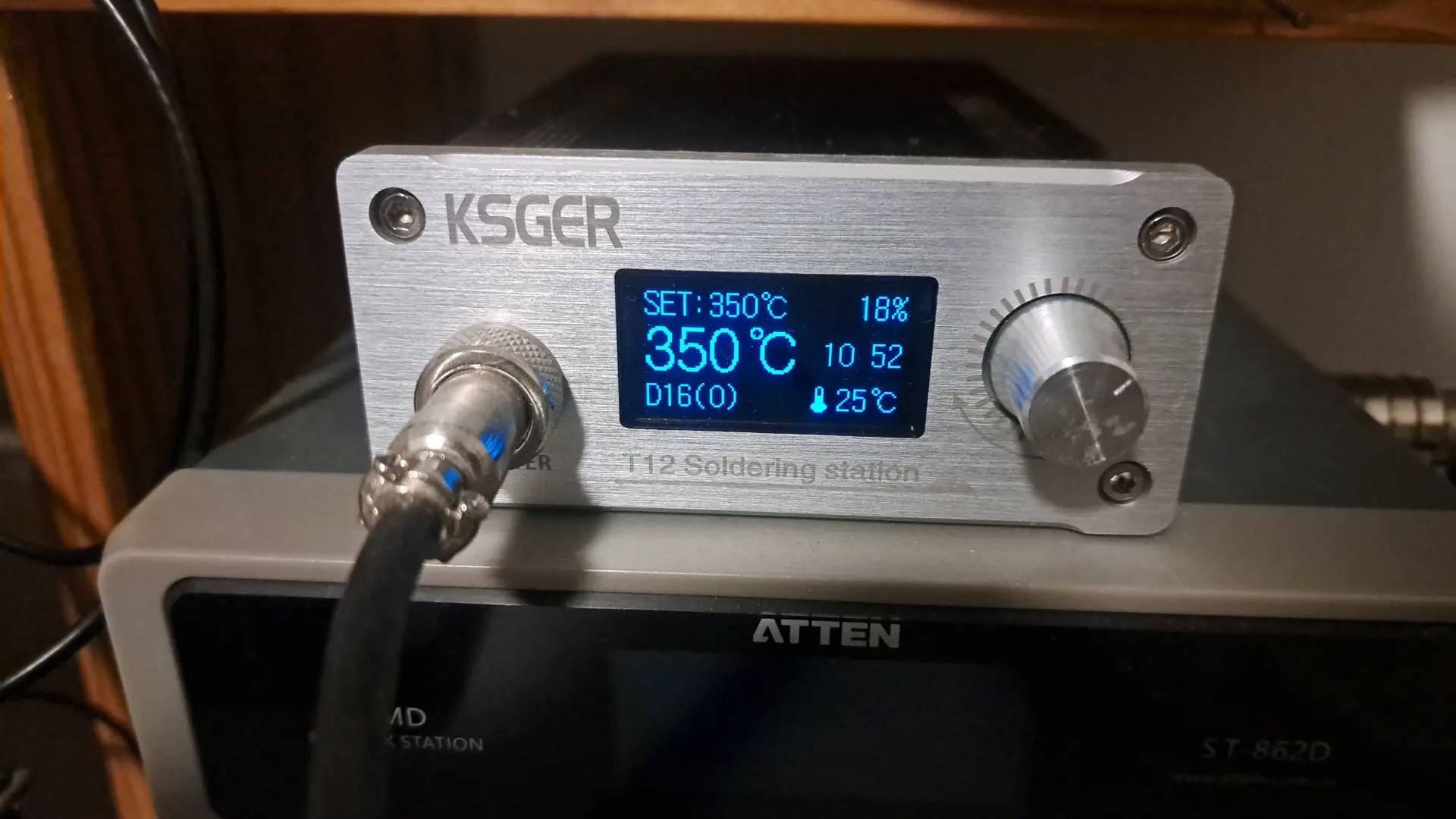
Why is tip type is important?
Modern cartridge-style soldering tips such as the T12 and C245 soldering cartridges represent a significant improvement over older “dumb” tips like the Hakko 900M soldering tip used in many traditional soldering irons.
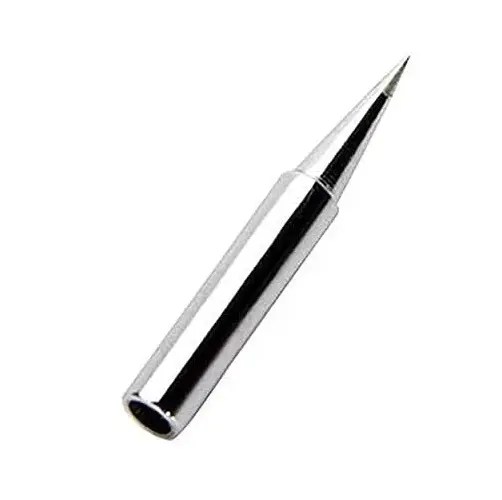
In older designs, the heating element and temperature sensor are located inside the iron body, with the removable copper tip simply acting as a passive thermal conductor. This creates a relatively long thermal path and often leaves small air gaps between the heater and tip, reducing heat transfer efficiency and slowing thermal response. Cartridge tips integrate the heater and thermocouple directly into the tip itself, placing the heat source and temperature sensing only millimetres from the working surface. This design dramatically reduces thermal resistance, allowing the tip to heat up in a few seconds, recover temperature rapidly

Modern T12 cartridge internals
At time of writing, the newer C245 cartridges (not compatible with T12) offer a slight improvement over the T12 tips, but they are less available and carry a higher cost.
Must-Have Tips (Cover ~90% of Projects)
These two tips alone will cover most soldering needs:
T12-D24 – Standard Chisel Tip
Perfect for most through-hole work; if you only ever do through-hole soldering, this could be the only tip you’ll ever need.
T12-BC1 – Small Beveled Tip
Extremely useful for SMT components, especially for drag soldering.
Nice-to-Have Tips
T12-D16 – Smaller Chisel Tip
Useful for small through-hole and some SMT work. Together with the D24, it gives a versatile beginner selection.
T12-K – Knife Tip
Larger contact area and thermal mass make it ideal for stubborn joints or tinning larger areas of bare copper.
T12-ILS – Fine Conical Tip
Sharp point can reach tricky spots, but rarely needed; keep it as a last resort option.
Multimeter
Zotek ZT111 (a.k.a. ANENG AN8009 / Richmeters RM111)
The Zotek ZT111 can often be found for around $20 and is very well suited to low-voltage hobby electronics.
This meter is also sold as the ANENG AN8009 and Richmeters RM111 — they are electrically the same.
Buy whichever is cheapest. The ANENG rebrand in particular tends to be overpriced.
Important: I do not recommend using this meter on mains voltage. For mains work, see my next recommendation instead.
Here’s why I like it:
- 9999 count – This means the meter scales in powers of ten (0–9.999, 0–99.99, 0–999.9), which makes readings much more intuitive than the awkward jumps you get on cheap 2000-count meters (1.999, 19.99, 199.9)
- Fast auto-ranging – unusually quick and unobtrusive for a meter at this price
- Runs on 2× AAA instead of a 9 V – cheaper, easier to find, and rechargeable-friendly
- Huge, high-contrast display – extremely easy to read
- Fast update rate – makes probing signals feel responsive
- Accurate – meets or exceeds its ratings in all my testing
- Full Range of Functions
And some added extras:
- Temperature measurement with probe included
- Frequency measurement up to 6 MHz – surprisingly useful and a very good range for a budget meter
UNI-T UT139C (Mains-Safe Option)
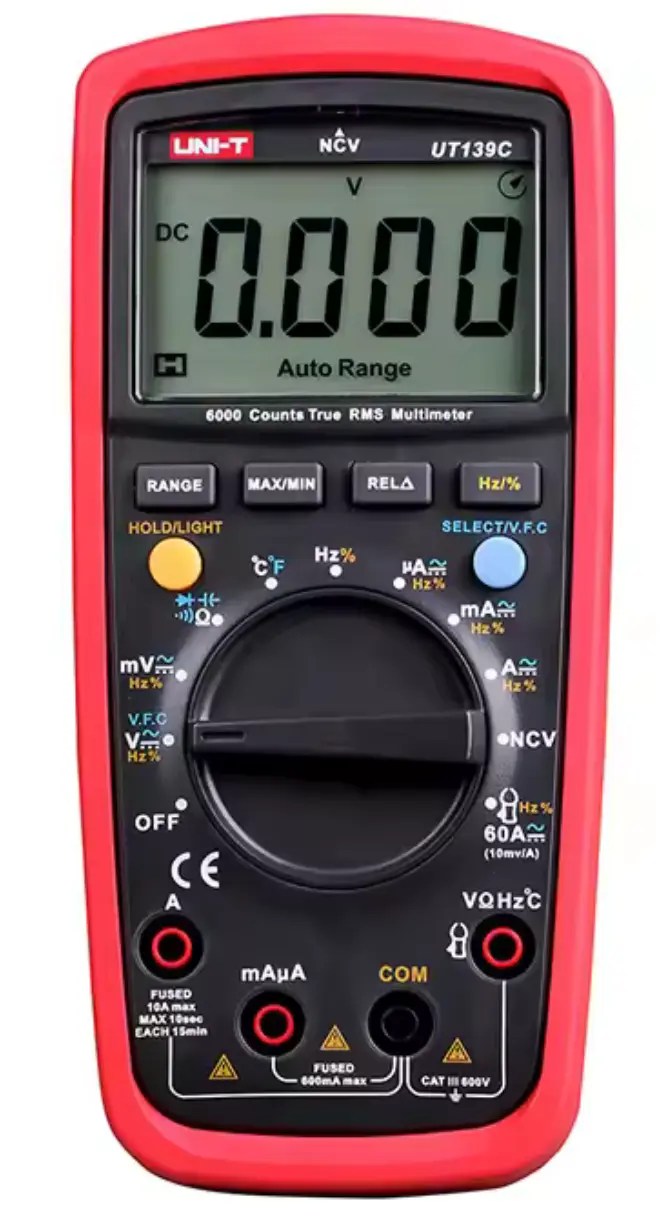
There’s nothing flashy or unique about the UNI-T UT139C, but at around $50, it’s one of the cheapest multimeters where I actually trust the CAT III safety rating to be legitimate.
If you plan to work on mains voltage or other higher-energy circuits, this is the better and safer choice compared to budget hobby meters.
Here’s why I like it:
Proper Input Protection
- 600 mA and 10 A fuses, both 600 V rated
- The 10 A fuse is certified to 10 kA breaking capacity, which is what actually matters for safety
- Four MOVs and two PTCs protecting the meter’s internal circuitry
True RMS Current Measurement
- Important for accurate AC power measurements, especially with non-sinusoidal loads
Power & Usability
- Runs on 2× AA batteries instead of a 9 V – cheaper, easier to find, rechargeable-friendly
- Fast auto-ranging – responsive and unobtrusive, just like the meter above
- Fast update rate – makes probing signals feel immediate
- Large, easy-to-read display
Useful Measurement Features
- Max/Min capture
- Relative (REL) mode for quick comparisons and offset measurements
If you never plan to touch mains voltage, the Zotek is perfectly fine. If you do, this UNI-T is the minimum tier of meter I’d personally recommend for safety.


Leave a Reply