
In this article I’ll show you how to set up and start developing with the CH32V003 and CH32V006 series of ultra-low-cost RISC-V microcontrollers.
The CH32V003/006 family
For anyone who hasn’t encountered them yet, the CH32V003 and CH32V006 series are remarkably capable for their price. Compared to an Arduino Nano based on the ATmega328P, which runs at 16 MHz, the CH32V003/006 operate at a blistering 48 MHz—three times faster. They also feature a modern 32-bit architecture instead of an 8-bit AVR core.
At around $0.25 per chip, it significantly outperforms comparable Atmel parts that still cost $2.00 or more.
The chips integrates a DMA controller, ADC, op-amp/comparator, multiple timers, and standard buses (USART, I2C, SPI). Operates on 5V or 3.3V –all GPIO is 5V tolerant, and there’s a single-wire debug/program interface.
One more standout feature is the built-in op-amp, which makes the CH32V003/006 especially well suited for directly interfacing with analog sensors.
The CH32V003/006 comes in several hobbyist friendly packages:
| Part Number | Package | Pin Count | Flash/SRAM | Notes |
|---|---|---|---|---|
| CH32V003J4M6 | SOP-8 | 8 | 16kB/2kB | Easy to solder, minimal peripherals |
| CH32V003A4M6 | SOP-16 | 16 | 16kB/2kB | Easy to solder. Most peripherals except SPI |
| CH32V003F4P6 | TSSOP-20 | 20 | 16kB/2kB | Trickier to solder (smaller pitch). All peripherals. |
| CH32V006F8P6 | TSSOP-20 | 20 | 62kB/8kB | 12bit ADC (Upgraded from 10 bit), 7 DMA channels. All peripherals. |
The CH32V006 is a newer addition to the lineup and costs about the same as the CH32V003F4P6 used in this tutorial (~$0.26 per chip). Unless you need one of the smaller package options not available with the CH32V006, there’s little reason to choose the CH32V003 over it.
Note: The CH32V003A4M6 does not have a functional SPI interface due to the absence of an SCK pin. If your project requires SPI, the CH32V003F4P6 is the recommended choice.
Parts You’ll Need
💡 Which board should you choose?
- Pre-made board: Fastest to get started, includes extras like a USB connector. (Note: The CH32V003/006 does not support USB; these boards use USB for power only)
- DIY PCB: Most cost-effective (~$0.30/board), minimal design, good grounding, pin labels, direct access to programming pins.
- DIP adapter: Budget-friendly and reusable. It works, but lacks a ground plane and requires installing the decoupling capacitor on the breadboard with long traces. No pin labels—you’ll need the datasheet handy.
No matter which board you select, you’ll want the programmer:
⚠️ Warning. There are two similar programmers. The WCH-LinkE and the WCH-Link. You need the WCH-LinkE version. See the user manual.
If you intend to DIY, you’ll want the microcontroller, these are available from the manufacturer’s official AliExpress store:
If you intend to breadboard, you’ll also need an TSSOP to DIP adapter:
Or alternatively:

This minimal development board is compatible with both the CH32V006F8P6 and the CH32V003F4P6.
The PCB is panelized and V-scored, with 15 snap-off dev boards per panel. When ordered through JLPCB, you receive five panels—yielding a total of 75 boards—for about $3.50. That works out to just $0.046 per board.
Pair that with bulk pricing from the WCH Store (around $0.24 per microcontroller), and you’re looking at a complete dev board for roughly $0.30 each. It’s hard to beat that.
If you’d like to customize the design, you can also download the full EasyEDA project for the dev board and modify it to suit your needs.
If you don’t want to DIY a board. You can also buy a:
Schematic

The schematic is very straight-forward. The only truly critical component is the C1 decoupling capacitor. It must be placed as close to the chip’s pins as possible and have a solid ground connection. That’s difficult to achieve on a breadboard, which is where the dev board becomes especially useful.
To program the chip, you only need to connect GND and SWIO to the corresponding pins on the programmer — just two wires at minimum. If you’re powering the chip from the programmer, you’ll also need to connect VCC.
I’ve included a few optional conveniences that you can omit if desired:
- A de-bounced reset switch
- An LED on GPIO PD3
WCH-LinkE Programmer
The CH32V003/006 series is programmed using the proprietary WCH-LinkE programmer. This is a low-cost, single-wire programming interface that also supports single-wire debugging (SWD). The official programmer additionally includes a USB-to-TTL serial interface, which can be used to monitor debug output.
Programmer – Linux
If you are on linux. I’ve included some additional instructions here to setup PlatformIO IDE on VSCodium, and how to configure udev rules for the programmer.
Programmer – Windows
When you first plug in the programmer, you’ll probably see that there are missing drivers in device manager:
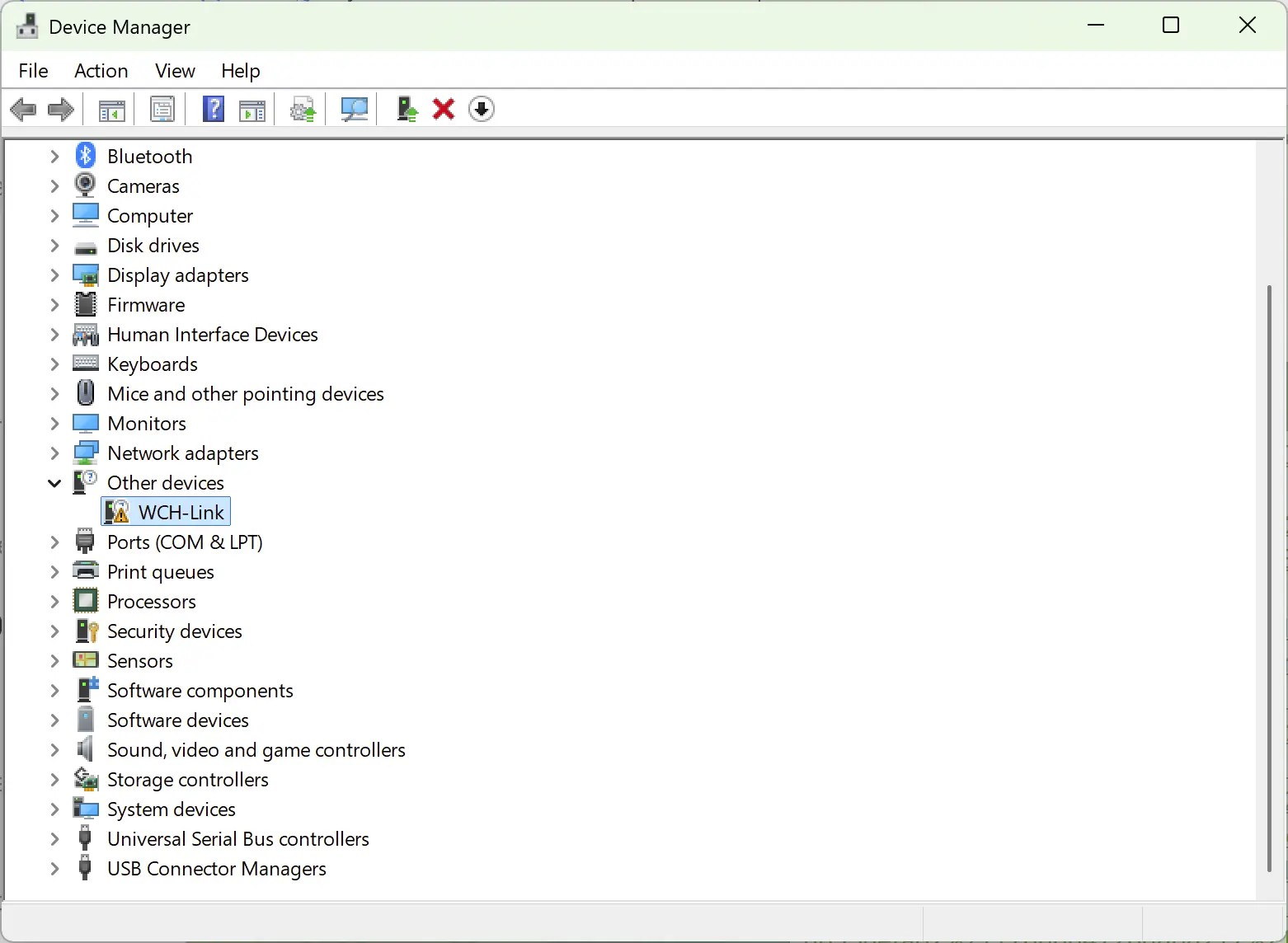
- Download the driver from GitHub https://github.com/Community-PIO-CH32V/wchlink-driver-windows/archive/refs/heads/main.zip
- Install the driver in the folder WCHLink and WCHLinkSER. These are the drivers for the programmer, and the programmer’s inbuilt TTL-USB serial device
- Check device manager and expand both “Ports (COM & LPT)” and “Interface” in the tree. You should see that both the WCH-LINK SERIAL and the WCH-LINKRV devices are present.

Once you see both drivers are working correctly, you can move onto the next step.
Set WCH-LinkE RISC-V mode.
The programmer supports both an ARM and a RISC-V mode. If the programmer is in ARM mode, you will see a blue LED illuminated. That’s bad if you want to program the CH32V003/006
If there is no blue led, you can ignore the rest of this and go straight to setting up the programming environment.
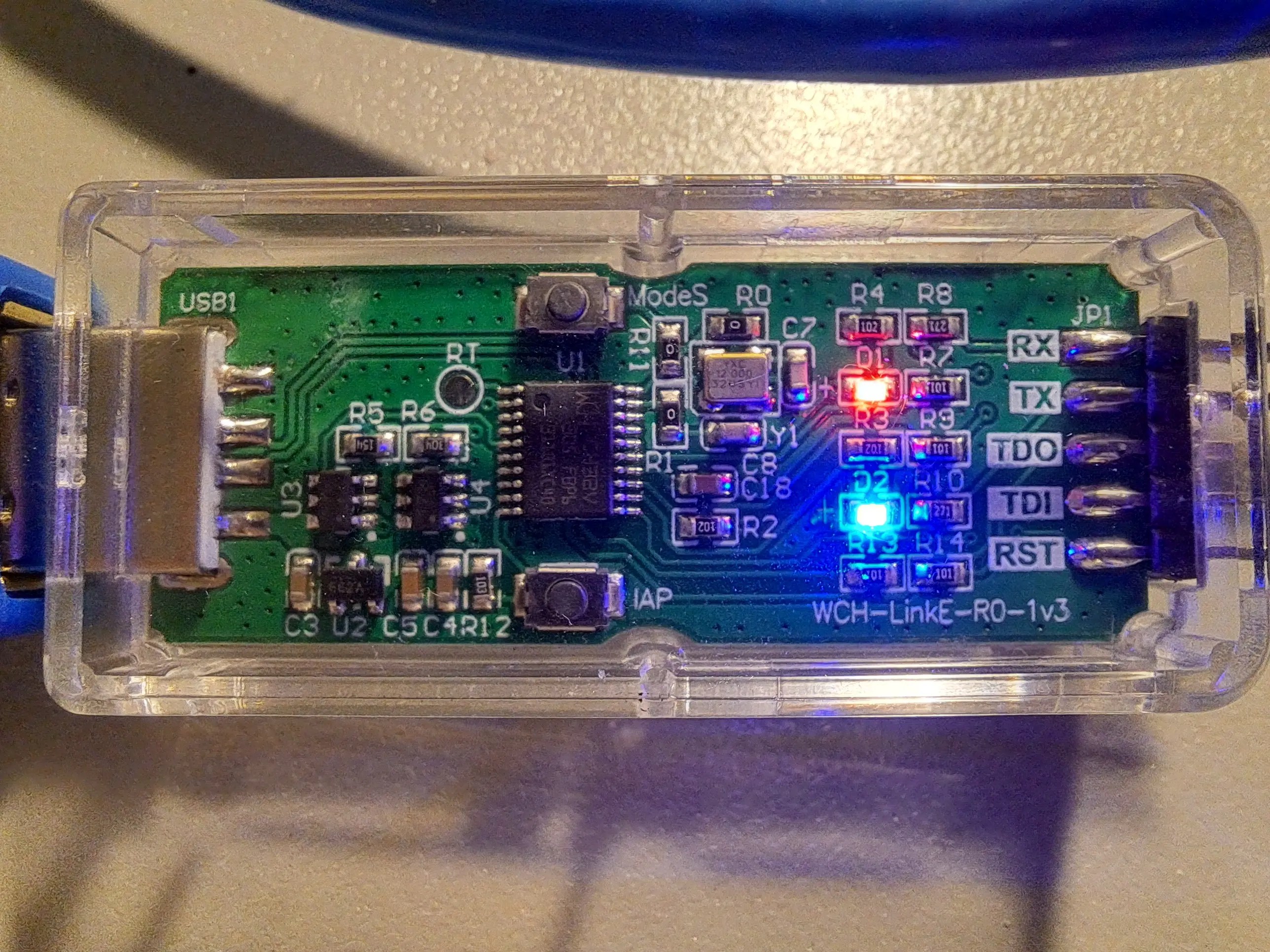
If the blue LED is lit, you have to swap the mode. Luckily, you only have to perform this step once, as the mode will be written to eeprom.
There are three options I’m aware of to set the mode:
- Hold down the ModeS button while you plug the programmer into your USB port (Case can be a bit tricky to open though)
- Download the WchLinkUtility https://www.wch.cn/downloads/wch-linkutility_zip.html
- Use the python rvmode.py utility
I went with the WCHLinkUtility. Unzip and run WCHLinkUtility and then:
- Press Refresh
- Select WCH-LinkRV in the “Active WCH-Mode:” drop down
- Press Set

The blue led should no longer be lit, indicating the programmer is in the RISC-V mode. You can go onto the next step.
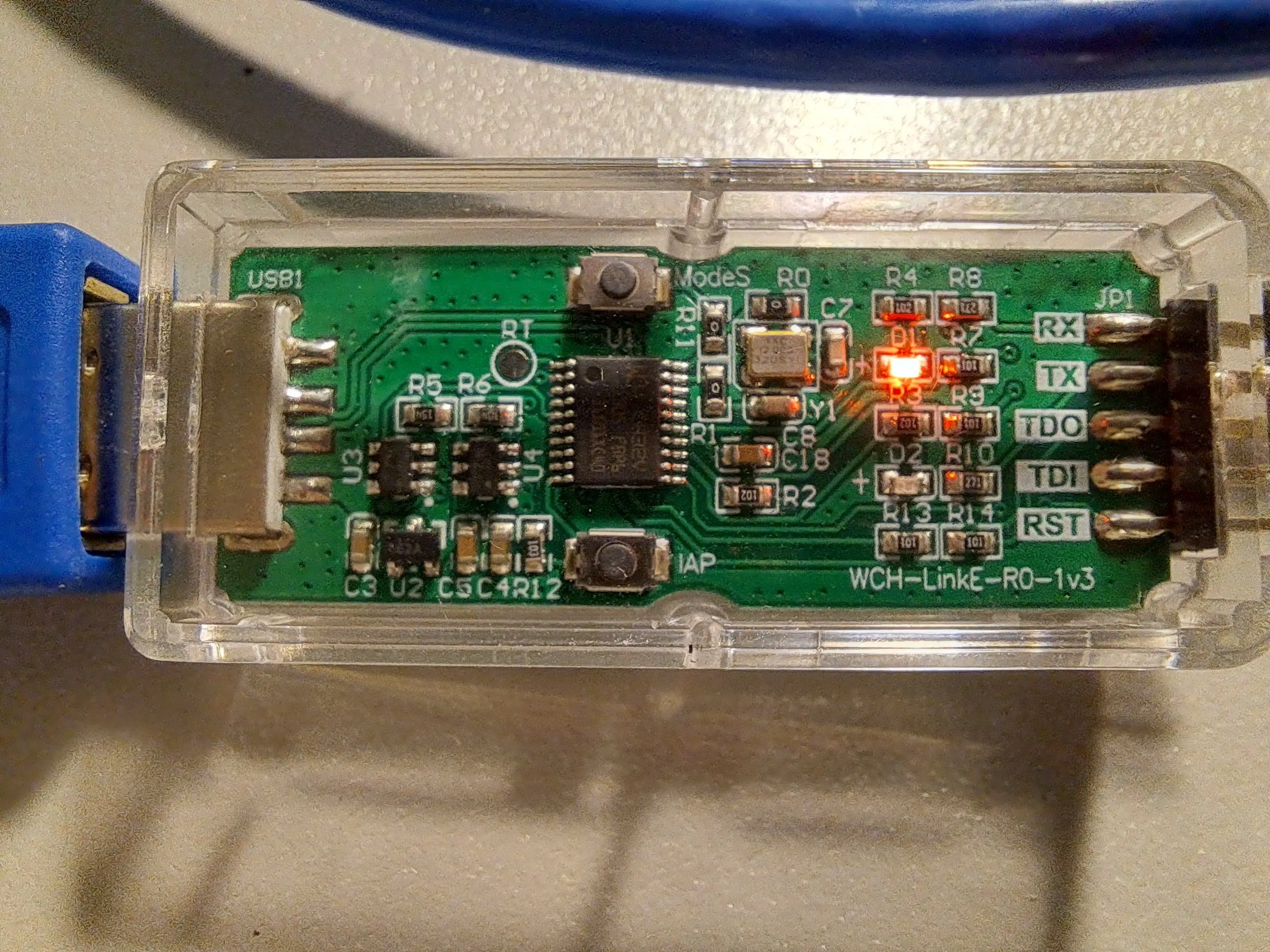
Update Programmer Firmware
My programmer worked out of the box with the CH32V003, but for the CH32V006 I needed to fist update the firmware.
Programmer Firmware – Windows
- Open WCH-LinkUtility.
- Select the correct IC from the Series drop-down menu.
- Click Query Chip Info.
If a firmware update is required, the utility will automatically prompt you to perform it.

Programmer Firmware – Linux
If you don’t have access to a Windows machine, you can use the open-source wlink-iap utility to update the firmware instead.
Connect the Programmer
Due to the SWD (Single-Wire-Debug) programming support. Only three wires are needed, and all are connected directly to the corresponding pins.
| Microcontroller | Programmer |
|---|---|
| SWIO | SWIO |
| VCC | VCC |
| GND | GND |
| RST (Optional) | RST (Optional) |
The programming wiring is so simple, it’s almost not worth this table.
Programming Environment
This setup is for the PlatformIO environment and the VSCode editor. There are options for Arduino IDE. But the PlatformIO solution is more mature, and debugging is supported out of the box!
Install PlatformIO Extension
- Open VSCode Extension Manager
- Search for official PlatformIO IDE extension
- Install PlatformIO IDE.
- Restart VSCode

Add WCH32 support
Support for the WCH32 isn’t currently included by default with PlatformIO. This support needs to be added
- Select the PlatformIO icon (Ant head icon on the left)
- Select Quick Access -> PIO Home -> Platforms
- Select Advanced Installation

Next, paste in the following URI:
https://github.com/Community-PIO-CH32V/platform-ch32v.git

Press Install. If successful, you’ll be greeted with something like:

Create a new WCH32 project
Create a new project
- Select the PlatformIO icon (Ant head icon on the left)
- Select Quick Access -> Open -> New Project

In the new Project Wizard
- Enter a name ‘ch32-blink’
- Select board Generic CH32V003F4P6(W.CH) (Or the CH32V006F8P6(W.CH))
- Select the Ch32v003fun framework (It supports both the CH32V003 and CH32V006 series)
- Click finish

Ch32fun is a lightweight, bare-metal development framework for WCH’s line of microcontrollers. Ch32fun takes a minimalist approach—it gives you just the essentials (headers, tooling, and a single-file library) so you can work directly with the hardware registers as described in the chip’s Technical Reference Manual.
Add Code
1. Create a new file /src/funconfig.h
Add the following contents:
_FUNCONFIG_H _FUNCONFIG_H// Place configuration items here, you can see a full list in ch32fun/ch32fun.h// To reconfigure to a different processor, update TARGET_MCU in the Makefile
funconfig.h is a per-project configuration header file that you create to customize how the ch32fun framework behaves for your specific application. It’s automatically included by ch32fun.h and serves as the main way to configure various system settings before the framework initializes.
We don’t need to configure anything now, but common settings you’d define in funconfig.h include:
- FUNCONF_SYSTEM_CORE_CLOCK – Sets the target CPU clock speed (e.g., 48MHz )
- FUNCONF_USE_DEBUGPRINTF – Enables fast printf debugging over the programming interface
- FUNCONF_USE_UARTPRINTF – Enables printf over UART instead
- FUNCONF_UART_PRINTF_BAUD – Sets UART baud rate (typically 115200)
- FUNCONF_SYSTICK_USE_HCLK – Configures whether SysTick runs at full CPU speed or divided
- FUNCONF_USE_CLK_SEC – Enables the clock security system
- FUNCONF_DEBUGPRINTF_TIMEOUT – Sets timeout for debug printf operations
2. Create a new file /src/main.cpp
Add the following contents:
"ch32fun.h" <stdio.h>// use defines to make more meaningful names for our GPIO pins PIN_LED PD3int main(){ SystemInit(); funGpioInitAll(); // Enable GPIOs funPinMode(PIN_LED, GPIO_Speed_10MHz | GPIO_CNF_OUT_PP); // Set PIN_1 to output while (1) { funDigitalWrite(PIN_LED, FUN_HIGH); Delay_Ms(1000); funDigitalWrite(PIN_LED, FUN_LOW); Delay_Ms(1000); }}
Remember to adjust the PIN_LED define for your board.
Upload
Click the upload button in the bottom right — you can also use the items in the Quick Access under Platform IO

If everything worked you should see a green [SUCCESS] message and your LED will begin blinking.
Debugging
One of the most pleasant surprises about this chip is its fully featured debugging interface, supported over the same single-wire connection used for programming.
No additional setup is required to debug your project in real time. Simply set a breakpoint and click the menu item Run → Start Debugging.
A breakpoint will be hit at the very beginning of the project—ignore this and press continue. Your breakpoint should be hit next.
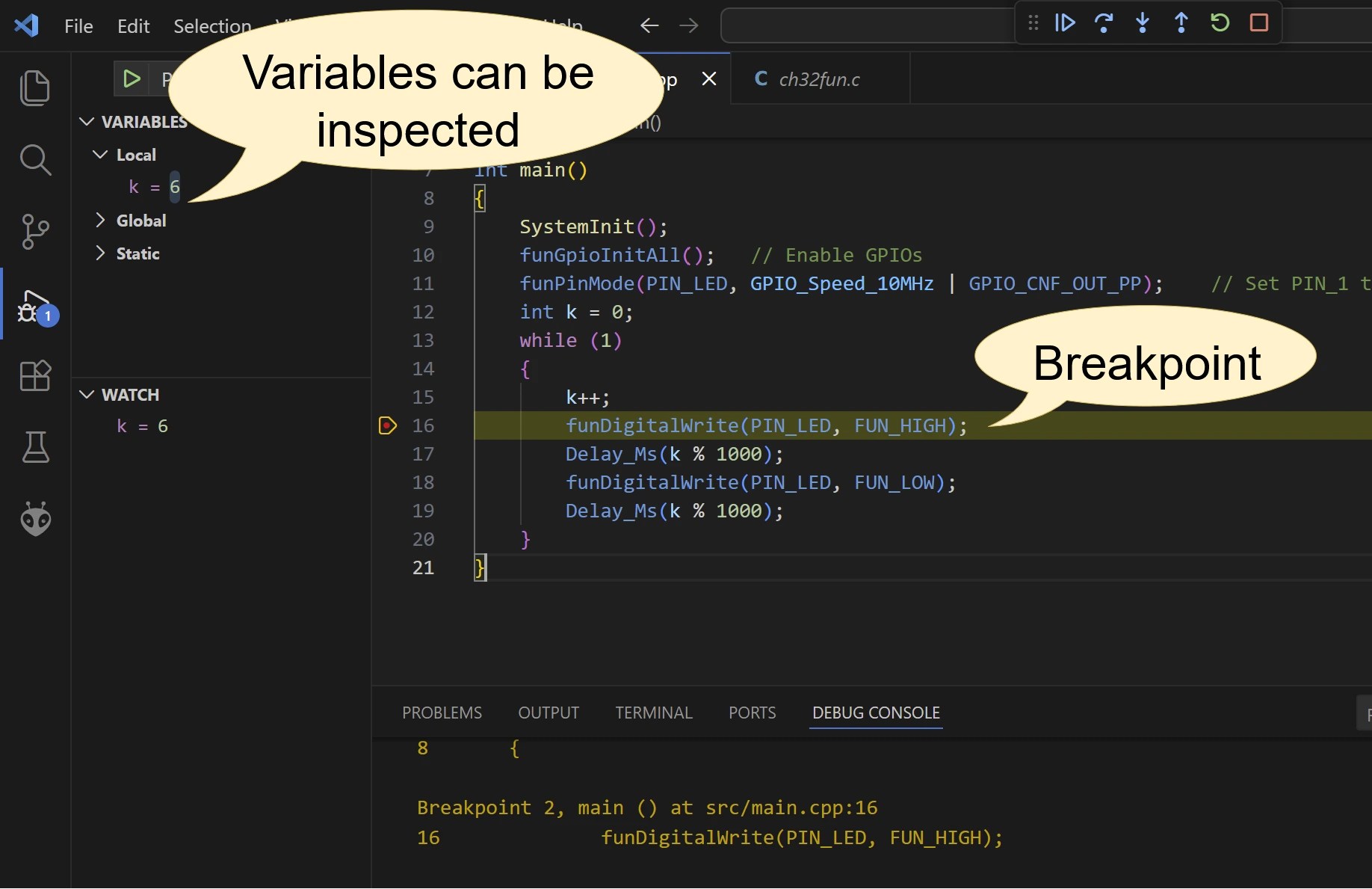
That’s it, congrats, you’re done!
Next Steps
For the next steps, I suggest checking out the examples included with the ch32fun framework. There examples demonstrate how to perform most common tasks on the CH32.
I also suggest reading the reference manual


Leave a Reply