-
This quick little project lets you send data from your PC to your raspberry pi, over a laser! We will however need a few components that may not be in our usual junk-box. So let’s take a quick look at these, and discuss which of their parameters are important to our project. First up, we… …Read More
-
In the early days of metal detecting, a simple type of detector known as a BFO (Beat Frequency Oscillator) was commonly used. While it does not perform as well as more modern designs, it is quick and easy to build, and may still be good enough for beachcombing for coins or rings. A traditional BFO… …Read More

-
This is a quick description of how to get a bootloader onto a blank STM32F103 (bluepill) using the Raspberry Pi 3 Preparing the Raspberry Pi 3 Install the stm32flash utility: Next move the high performance UART from the Bluetooth device to the GPIO pins by editing /boot/config.txt Add the following line to the file: dtoverlay=pi3-miniuart-bt Next… …Read More

-
The pulse-width-modulated output of an arduino is often used in conjunction with a small piezo-electric speaker to create tones and music. This simple approach works well; but if you try to scale up this approach and use a larger speaker, you’ll find the power output of the digital IO pin is not sufficient to drive it properly. To drive a… …Read More
-
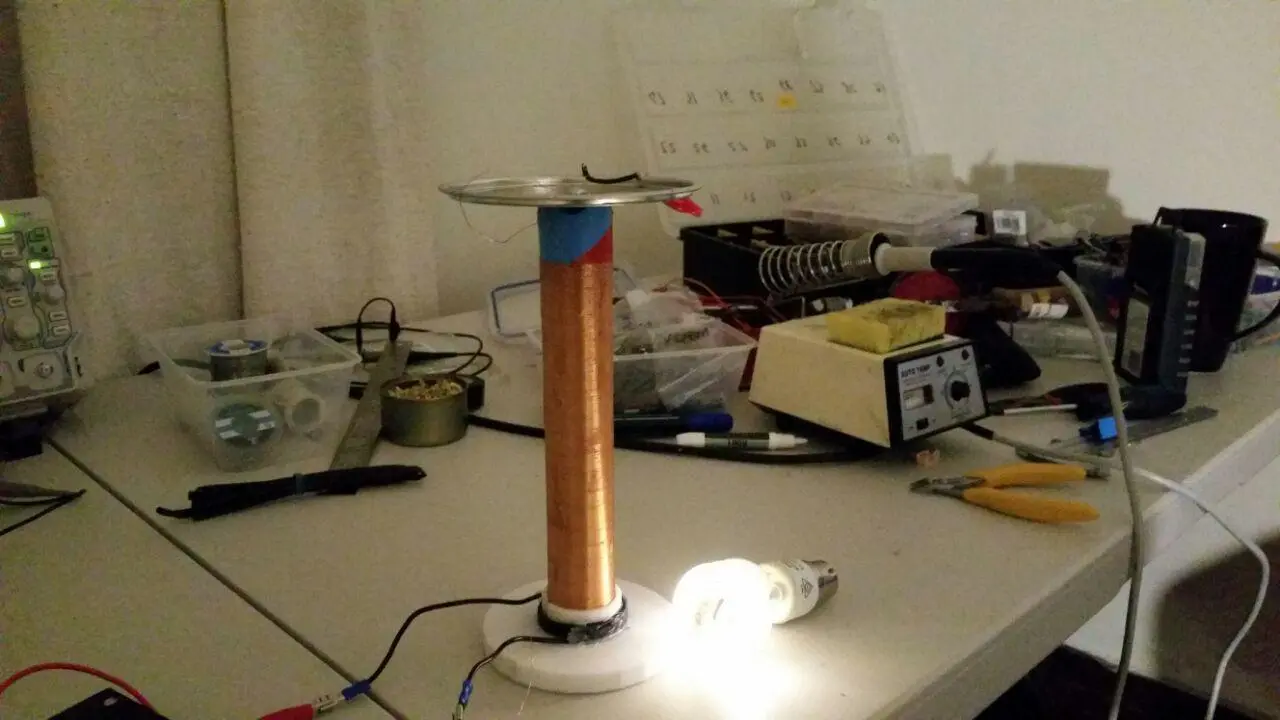
In my previous post I discussed my build of the slayer exciter Tesla coil and provided a few tips to make the circuit a little more robust. This post is a follow-up with a more advanced and much more powerful version of the slayer exciter. This updated design addresses a couple of key shortcomings of… …Read More
-
Building a Tesla coil feels almost like a rite of passage—my life didn’t feel quite complete until I built one myself. This project can be frustrating, and I won’t sugarcoat it: you’re likely to blow a few transistors before everything works. Fortunately, I discovered a few tricks along the way that can help save some… …Read More
-
Like most dangerous activities, playing with high voltage is a lot of fun. Sadly, I only have access to a measly 30V from my lab PSU. How can I go from this pitiful voltage up to a more substantive tens-of-thousands of volts one may ask? Well, one of the easiest way is to make use… …Read More
-
I was looking for an adjustable oscillator to use as a frequency source for my Tesla coil. From previous testing, I already knew the coil resonated at approximately 2 MHz, since I had built a Slayer-exciter circuit earlier and measured its operating frequency. A common first choice for a simple oscillator is the 555 timer.… …Read More
-
In the past few weeks I’ve been interested in the history of amplifiers and radio. The first amplifiers used only requires only a single amplification device and are known as Class A amplifiers. Class A amplifiers were popular in the early days because vacuum tubes were expensive and prone to blowing. The less of them you used,… …Read More
-
Continuing on from part 1. We are still testing whether cheap op-amps from eBay match the specifications expected for an LM358. The goal is twofold: to determine whether the parts are likely genuine and to gain a deeper understanding of how an op-amp datasheet relates to real-world behavior. In Part 1, we examined the op-amp’s… …Read More